
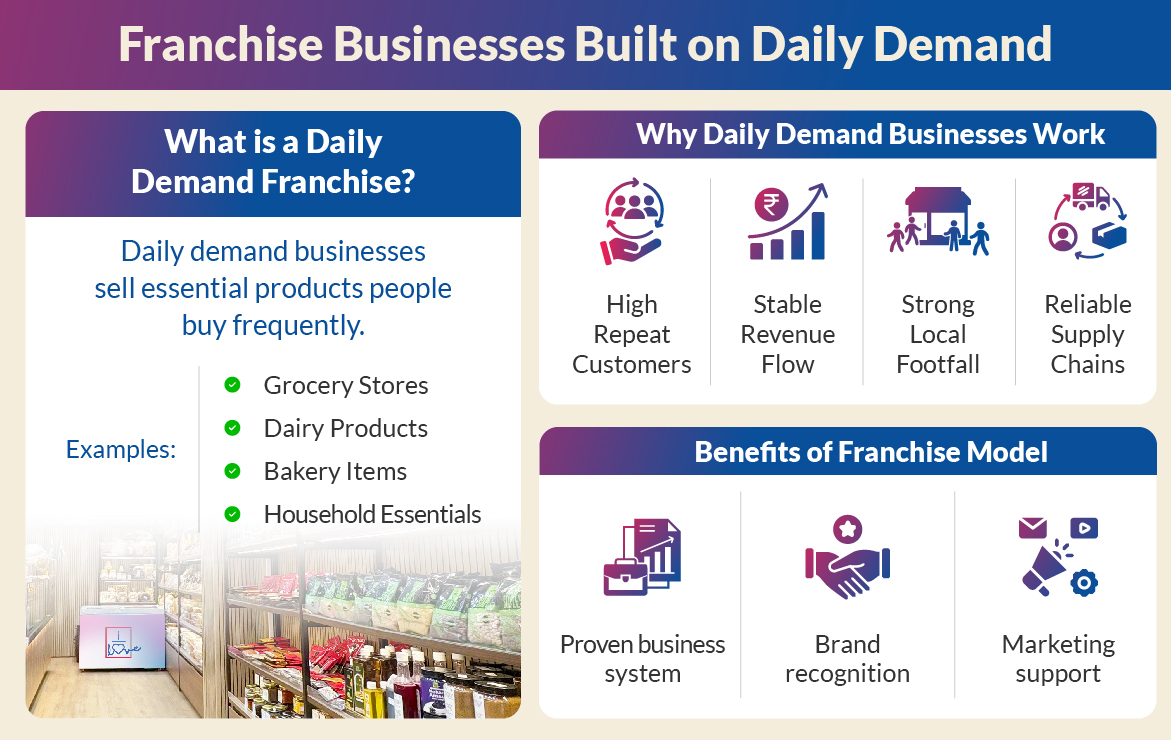
In today’s competitive business environment, choosing the right franchise model is as important as choosing the right brand. While many franchises depend on seasonal trends, discretionary spending, or lifestyle cycles, businesses built on daily demand offer a far more stable and sustainable growth path. Food and grocery franchises stand out as one of the smartest investment choices for long-term success.
Daily demand businesses operate on a simple truth: people need food every single day. Unlike fashion, entertainment, or luxury services, food consumption is non-negotiable. Groceries, staples, snacks, and ready-to-eat items are purchased repeatedly, creating predictable footfall and consistent revenue. This makes daily-demand franchises inherently resilient, even during economic slowdowns or changing consumer trends.
What makes these franchises even stronger is repeat customer behaviour. A customer may buy a product once from a specialty store, but grocery and food purchases happen multiple times a week. When a brand delivers quality, hygiene, and fair pricing, it becomes part of a customer’s routine. Over time, this routine turns into loyalty, reducing marketing costs and stabilising income for franchise partners.
Another advantage of daily-demand franchises is faster business stabilisation. Inventory moves quickly, cash cycles are shorter, and unsold stock risks are lower compared to slow-moving categories. This allows franchise owners to manage working capital efficiently and maintain healthier margins. For first-time entrepreneurs, this operational predictability reduces stress and decision fatigue.
Organised food and grocery franchises also benefit from system-driven operations. Centralised sourcing, standardised pricing, hygiene SOPs, and structured workflows ensure consistency across locations. Franchise partners don’t need to experiment endlessly they follow proven systems designed to work at scale. This balance of independence and support is critical for long-term growth.
Modern daily-demand franchises go beyond traditional retail. Formats that combine essentials with high-frequency consumption elements such as live food counters or ready-to-eat offerings create multiple revenue streams under one roof. Planned purchases (like staples) and impulse consumption (like snacks or fresh food) together increase average billing and customer visit frequency.
From an expansion perspective, daily-demand franchises scale logically. Neighbourhood-based models allow brands to penetrate dense residential zones without heavy infrastructure costs. Smaller store formats, local relevance, and repeat-driven sales make expansion both practical and profitable.
Most importantly, daily-demand franchises are built for longevity, not hype. They grow steadily, serve real needs, and adapt easily to local markets. For investors and entrepreneurs seeking dependable returns, operational clarity, and long-term brand value, franchises rooted in everyday consumption offer a smarter, safer path to growth.
Choosing a franchise built on daily demand isn’t just a business decision it’s a strategic investment in consistency, relevance, and sustainable success.