
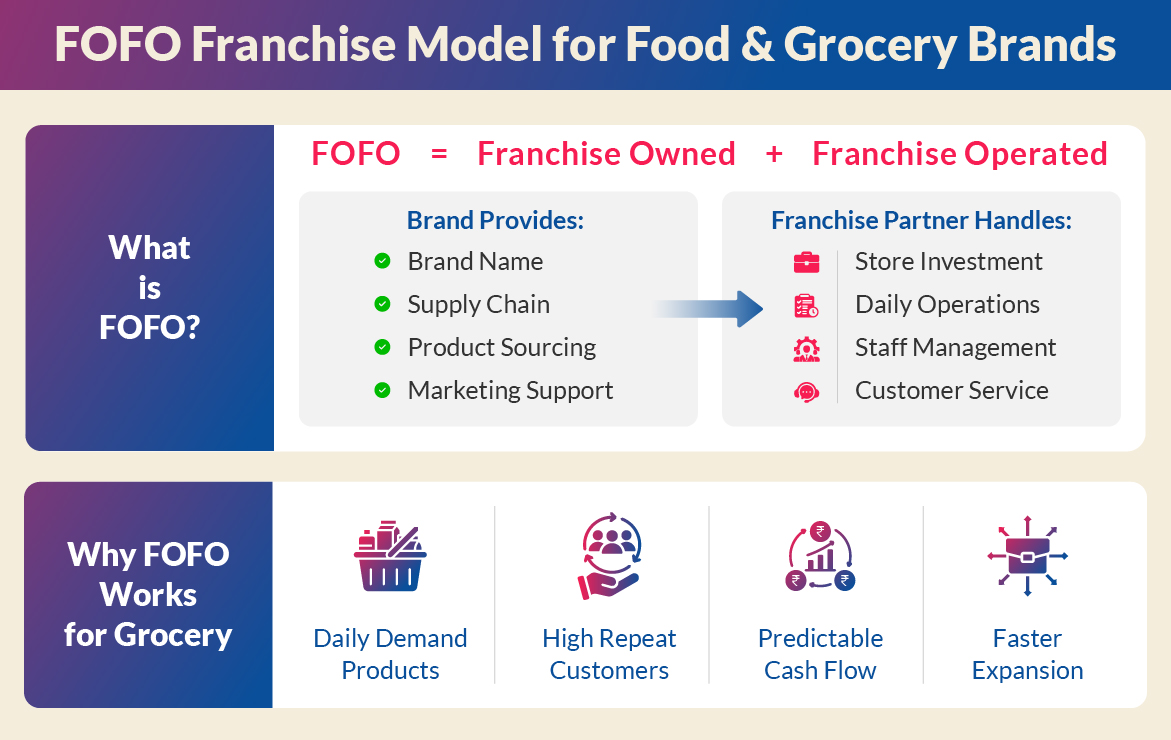
The food and grocery sector is one of the most demanding categories in retail. It operates on daily consumption, thin margins, high operational discipline, and zero tolerance for inconsistency. In such an environment, choosing the right expansion model is not just important it is critical. This is where the FOFO (Franchise Owned, Franchise Operated) model proves to be the most effective structure for food and grocery brands.
Unlike company-owned or manager-operated formats, the FOFO model places ownership and daily operations directly in the hands of the franchise partner. This creates a powerful advantage: personal accountability. When the store is owned and operated by the franchisee, every aspect hygiene, staffing, customer experience, inventory control, and local marketing receives constant attention.
In food and grocery retail, success depends heavily on discipline. Products are perishable, footfall is routine-based, and customer trust is built over time. Owner-operated stores consistently outperform managed outlets because the franchise partner is emotionally and financially invested in the store’s performance. Decisions are faster, wastage is lower, and customer relationships are stronger.
At the same time, food brands cannot afford to lose control over quality and consistency. This is where strong central oversight becomes essential. In a well-designed FOFO model, the brand governs procurement, hygiene SOPs, pricing frameworks, menu design, and brand communication. This ensures that customers experience the same standards across every location, regardless of who operates the store.
I LOVE STORE follows this balanced FOFO approach. Franchise partners manage daily operations, while the brand controls sourcing, live-counter SOPs, hygiene protocols, and marketing systems. This structure allows the brand to scale without diluting its promise of quality, cleanliness, and consistency.
Another key advantage of the FOFO model is scalability without heavy capital burden. Since franchise partners invest in store setup and operations, the brand can expand across multiple locations and cities without overextending its balance sheet. This also allows franchisees to enter a proven business model instead of building systems from scratch.
From a franchise partner’s perspective, FOFO offers clarity and independence. The roles are well-defined, operating systems are already in place, and growth is driven by execution rather than experimentation. This significantly reduces risk, especially in the food and grocery sector where operational mistakes can quickly impact profitability.
Most importantly, FOFO aligns incentives. The brand focuses on long-term reputation and system strength, while the franchise partner focuses on daily performance and customer satisfaction. When both objectives align, the result is a stable, repeat-driven, and sustainable retail business.
In a category where consistency matters more than speed, the FOFO franchise model stands out as the most reliable path to growth. For food and grocery brands looking to scale responsibly, it is not just a model it is the foundation for long-term success.